Shaping the future for 250 years: HfG anniversary ceremony at the Prediger
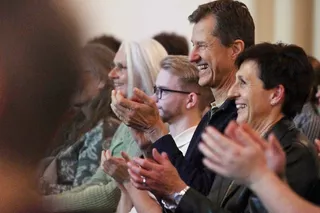
On 5 November 2026, with around 300 guests from the worlds of politics, academia, culture and the design profession, we celebrated our 250-year history – whilst placing the social responsibility of design at the centre of the event.
The programme spanned the spectrum from our historical roots right into the 21st century. Rather than simply looking back, we focused on a key question: How can design fulfil its social responsibility today and in the future?
Tradition meets transformation
In her welcoming address, Petra Olschowski, Minister for Science, Research and the Arts in Baden-Württemberg, praised our university’s standing within Baden-Württemberg’s higher education landscape: “Good design improves our lives. It does not merely create beautiful things – it changes the way we live, work and interact with one another. This is what the Schwäbisch Gmünd University of Design has stood for over the past 250 years. What once began as a drawing school is now a university with a profile that is unique in Germany. Here, students combine creativity, technology and practical experience to develop solutions for the future. This is precisely the combination we need: Baden-Württemberg aims not only to conceive of innovation in technical terms, but also to shape it. For 250 years, the Schwäbisch Gmünd University of Design has demonstrated just how much can be achieved when design and applied science work together.”
Mayor Richard Arnold also offered his congratulations and highlighted the close ties between the town and the university: ‘Our creative spirit and the courage to embrace change have had a positive impact in many areas of Schwäbisch Gmünd.’ Looking ahead, he appealed to our sense of community and emphasised that there is no need to fear the future as long as people remain at the heart of our work and the community stands united.
In her keynote address, ‘Looking Back to Move Forward’, our Vice-Chancellor Maren Schmohl took an open and critical look at our past, which – following early links to the Bauhaus – also includes the dark period of National Socialism. Our founding commitment to the ideas of the HfG Ulm remains valid to this day and guides us in our ongoing task of strengthening and protecting democracy through our work.
Keynote: Design as a Negotiation for the Future
Prof. Annette Diefenthaler (Technical University of Munich / Munich Design Institute) set the thematic focus for the evening with her keynote address, ‘Negotiating the Future – Design between Craftsmanship, Hope and Agency’.
In the face of rapid technological upheavals and social crises, Diefenthaler argued that design should be understood as a collective tool for shaping the future, one that restores people’s capacity for action: “What design does well is to use imagination to create new ideas and bring them to life. What design must be able to do in future: share this imagination with other people, so that futures can be experienced, negotiated and realised together,” said Diefenthaler. The traditional craft of design is more important than ever – “only now the material is no longer just wood, fabric or pixels, but our shared future.”
Futuring: Our students bring ‘spaces for thought’ to life
Our students demonstrated how we embed this approach in our teaching through two speculative projects in which the ‘futuring’ method was applied:
‘Biodiversity 2100’: This project visualises the consequences of species extinction in two extreme, plausible scenarios for the year 2100. The dystopian ‘The Last Species Museum’ displays the last remnants of nature as priceless luxury items behind glass. In contrast, the utopian ‘Carbon Crimes Museum’ exhibits relics of the fossil fuel era – such as single-use plastic bottles or chainsaws – as mistakes of the past that have been overcome. This juxtaposition illustrates that the future is not predetermined, but is negotiated in the here and now.
‘Embrace Ambivalence’: A strategic future scenario for the year 2042, using the writing instruments manufacturer STAEDTLER as an example. The project responds to the increasing automation driven by AI with two deliberately contradictory product ranges: the ‘Fast Lane’ (Mars Note) for software-supported, networked team creativity in real time, and the ‘Slow Lane’ (Mars Mind) as a mindful, screen-free retreat for analogue reflection and sketching.
A visual kaleidoscope
To round off the event, our media installation ‘Visual Kaleidoscope: 250 Years of Design and Creation’ made its debut. Across five screens displaying synchronised footage, a journey through our university’s history unfolded: images from various archives relating to 6,500 projects were sorted into 75 themes and presented in a random order. This brought 250 years of design history to life – from the drawing school founded in the 18th century, through the era of the Werkkunstschule, to the HfG in its digitally networked present.
We would like to thank everyone involved
We would like to thank all members of the university community, both in the spotlight and behind the scenes, for their tremendous dedication, as well as all our guests, who brought this special anniversary evening to life with their presence and engaging conversations.
Photo credits for “Visual Kaleidoscope”: Leon Beu


