Double success at the UX Design Award 2026: two master’s theses honoured
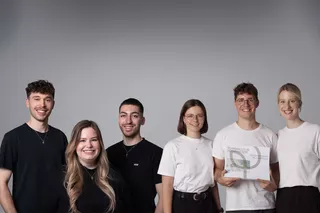
The fact that the HfG’s Master’s students are at the cutting edge with their work is demonstrated by the recent presentation of the prestigious UX Design Award (Autumn 2026), at which two of their projects were honoured in the ‘New Talent’ category. The project “Hi:Stories – next door” won the UX Design Award Gold. Both projects impressed the international expert jury with their systemic approach, outstanding user guidance and their contribution to pressing social challenges.
The awards once again underline the high quality of the design education at the HfG Schwäbisch Gmünd and demonstrate how, through well-founded user experience design, complex systems can be made understandable and socially relevant topics can be communicated in a contemporary way.
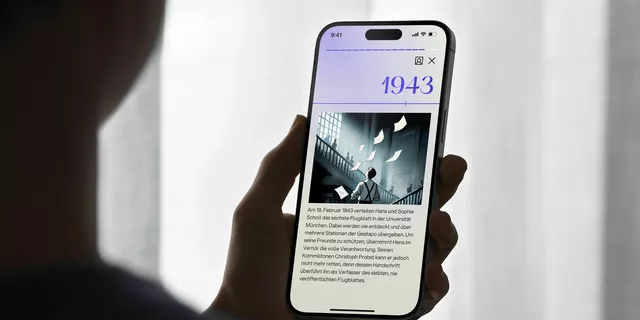
Hi:Stories – next door
How can the memory of the Nazi era be conveyed to young people aged between 14 and 19 in a lasting and contemporary way – particularly at a time when fewer and fewer eyewitnesses are able to recount their experiences first-hand? Adrian Jans, Sarah Müller and Marc Schade addressed this question in their Master’s thesis “Hi:Stories”.
The project combines digital and hybrid formats to embed historical awareness in young people’s everyday lives and to strengthen democratic values. A particular challenge lay in striking a delicate balance: the target group’s fast-paced viewing and usage habits, shaped by social media, had to be reconciled with a respectful and dignified approach to the fates of the victims of National Socialism. Rather than relying on pre-packaged narratives, “Hi:Stories” links real locations in the urban landscape with original documents (including through a conceptual collaboration with the Arolsen Archives) and enables young people to establish personal connections with the biographies.
The Master’s thesis was supervised by Gabriele Niki Reichert and Dr Dagmar Rinker. In its statement of reasons, the expert jury emphasised that Hi:Stories offers a captivating interactive concept. Historical material comes to life directly within the city, and every design decision demonstrates the sensitivity that this subject demands. The visual language is calm, precise and dignified. The project encourages reflection and makes an indispensable contribution to preserving historical understanding.
Permetrix – Transition to Regenerative Farming
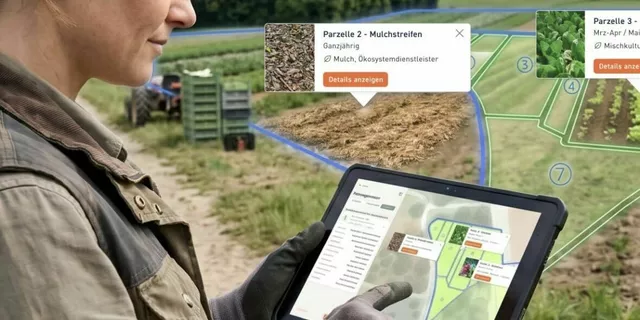
The transformation of agriculture towards environmental sustainability entails significant personal and financial risks for farms. With ‘Permetrix’, Master’s students Agnes Kloos, Friederike Kohler and Peter Swirsky have developed an AI-powered planning tool that guides farms, step by step, through the transition to regenerative, permaculture-based systems.
The tool brings together site analyses, zoning, planting strategies, monitoring and community knowledge within a seamless, visual workflow. The greatest UX challenge lay in translating the highly complex interplay of ecological parameters and business decisions into an intuitive and credible interface. Through visual structures, targeted user guidance and gamification principles, the team succeeded in presenting abstract knowledge systems in a tangible and action-oriented way.
The project was supervised by Dr Susanne Schade and Leif Huff. The jury of the UX Design Awards particularly praised the systemic approach: Permetrix treats change not as a purely technological problem, but as a systemic challenge, by combining planning, monitoring and peer learning. The depth of the research, the systemic thinking and the courage to make a risky transition scenario manageable had made a lasting impression on the jury.
Both projects illustrate that design goes far beyond purely aesthetic considerations: it serves as a strategic tool for enabling sustainable transformation and keeping democratic discourse alive.
We warmly congratulate Agnes Kloos, Friederike Kohler, Peter Swirsky, Adrian Jans, Sarah Müller and Marc Schade on this outstanding international recognition.