National success at the James Dyson Award: HfG students impress with their sign language wearable ‘NURA’
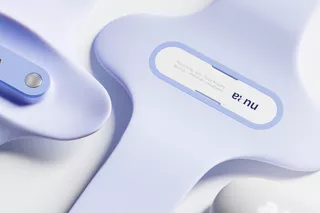
With their innovative NURA project, HfG students Samuel Nagel and Paul Feiler took second place at national level in the prestigious James Dyson Award. The smart wristband translates sign language and spoken language in real time and impressively demonstrates how user-centred design can break down social barriers.
The project originated from discussions with a sign language interpreter and officials at the Ministry of Health. It became clear that interpreters are often fully booked for months in advance and are expensive. As a result, deaf people often have to do without essential support at spontaneous gatherings, weddings or social events. In response to this issue, Samuel Nagel and Paul Feiler developed the vision for NURA, an independent, permanent support system that enables deaf people to enjoy greater autonomy in their everyday lives.NURA is a wrist-worn device that translates in both directions. When the wearer signs, EMG sensors on the inside of the wristband detect the electrical signals from the forearm muscles. These signals are translated into words in real time and output via a built-in speaker. When the other person responds, a microphone picks up the spoken language and converts it into text, which appears on an easy-to-read dot-matrix display on the wrist. In addition, two integrated wide-angle cameras capture the facial expressions essential for sign language. An intelligent algorithm also learns the wearer’s individual signing style, making the translation increasingly accurate. All of this works directly on the body, without a smartphone and without the need for a third party.
During the design process, our students placed particular emphasis on avoiding a stigmatising medical aid. NURA is designed as an elegant accessory that people enjoy wearing. Following initial tests of the core technologies, numerous sketches and form studies using silicone and 3D printing, a functional prototype was created. This currently utilises motion and position sensors and is already capable of recognising and audibly outputting six signs.
In addition to its success at the James Dyson Award, the NURA project has already secured first place at the Rimowa Design Prize, where the team was mentored by Tim Richter, Head of Industrial Design at Siemens Healthineers.
We congratulate Samuel Nagel and Paul Feiler on this outstanding achievement. NURA is an excellent example of how, at the HfG Schwäbisch Gmünd, innovation, technical feasibility and a high standard of design come together to create solutions that offer genuine social value.