Review of the Kreativforum Ostwürttemberg: Inclusion as a driver of innovation
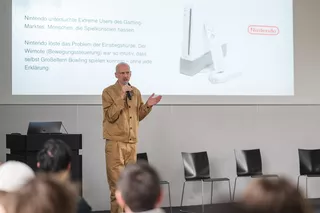
Under the title “Inclusion as a Driver of Innovation”, representatives from the fields of design, business and research joined over 60 guests in discussing the social and economic significance of accessible design.
The Creative Forum was organised by the Economic Development Agency for the East Württemberg Region (WiRO), the Schwäbisch Gmünd University of Design, the East Württemberg-Ostalbkreis Women and Work Contact Point, and the Economic Development Agency of the City of Aalen. The aim of the event is to address current developments and create a space for exchange between the creative industries, businesses and the university.
In her opening remarks, HfG Rector Maren Schmohl made it clear that inclusion should not be seen as an afterthought, but as a fundamental hallmark of good design. Products and digital services are often geared towards supposed ‘average’ users, thereby overlooking social diversity. An inclusive perspective, on the other hand, enables solutions that are accessible to more people and thus result in better design overall.
In their joint keynote presentation, Professors Marc Guntow and Ulf Harr demonstrated how early inclusion must begin in the design process – for example, in the legibility of an event poster or the accessibility of digital applications. They also referred to the legal framework: with the European Accessibility Act and the Accessibility Enhancement Act, accessible digital services are becoming increasingly important. A central tenet of inclusive design became particularly clear: designing for people with specific needs often improves the user experience for everyone.
Practical examples
Several final-year projects by HfG students demonstrated how this approach can be translated into innovative design in practice.
Luca Palanga and Victor Blaga presented Ausono, a system designed to support pupils on the autism spectrum. Using a microphone, lesson content is transcribed in real time, structured and presented visually to reduce sensory overload and facilitate focused learning.
Another project focused on communication in crisis situations. With onPoint+, Alicia Link and Robert Kremer developed an analogue and digital tool for disaster management designed to break down language barriers using visual and symbolic language. The aim is to enable emergency services to communicate easily with those affected, whilst also making self-help information more accessible.
Cultural participation was also a topic at the Creative Forum. Using his AI-powered tool, zebra, Joschua Rothenbacher demonstrated how audio descriptions for theatre performances can be created more efficiently. The application helps blind and deaf people to better experience live theatre, thereby contributing to a more inclusive cultural landscape. At the same time, the project highlighted that inclusive solutions do not necessarily entail additional costs, but can simplify processes and open up new target groups.
In the concluding discussion, it became clear that inclusion is far more than just a social responsibility. It opens up new perspectives on design, creates accessibility and acts as a driver for innovation – in design processes as well as in business and culture.